

AI Chatbots
Chatbots That Know Where Answering Ends
An AI chatbot answers questions from your own content, for customers or for staff. Webcoda builds chatbots with a deliberate line between answering and acting: if a question needs a judgement call or a change to a system, the bot hands off cleanly rather than guessing.
Who this is for
The same support questions, every day
A knowledge base nobody searches
A customer-facing bot giving wrong answers
What we deliver
-
01
A bot trained on your content, not the open internet
Answers come from sources you nominate, with the source shown, so a wrong answer is traceable to a page you can fix.
-
02
A clear escalation path
To a human, or to an agent, for anything past answering. Defined during design, not bolted on after the first complaint.
-
03
Integration into your existing platform
Your support desk, intranet or CMS. Conversations land where your team already works, with the context attached.
-
04
Content freshness checks
The failure mode of every chatbot is stale content. We build the review loop that catches it, and name who owns it.
Answering versus acting
| A chatbot answers | An agent acts |
|---|---|
| Retrieves and explains what your content already says. | Takes a judgement call inside a process and does something about it. |
| Wrong answer means a bad experience and a correction. | Wrong action means a changed record, and something to unwind. |
| Supervision is content review. | Supervision is monitoring, permissions and an audit trail. |
| Right when the volume is questions. | Right when the volume is decisions. |
A chatbot that starts taking actions without you deciding to build that in is a chatbot doing an agent's job badly. If you need action, not just answers, that is a different service.
AI AgentsWhat we have built
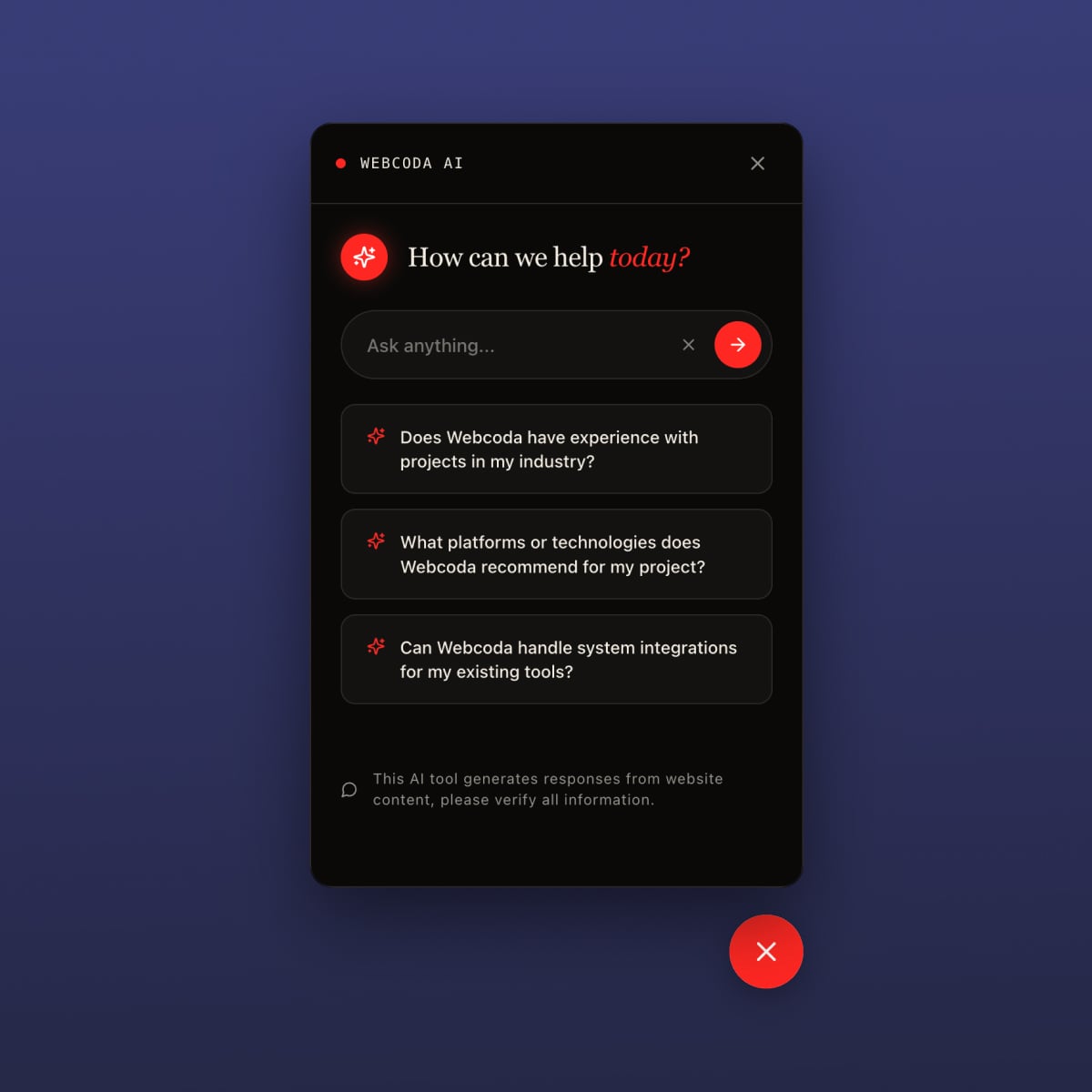
Webcoda.ai site assistant
We built this for our own site, and it changed how people find things. Instead of digging through menus or a search box, visitors just ask. The assistant uses RAG to answer from our actual pages, so every answer is accurate, current and in our words, not a canned script.
Your customers get instant answers, you get fewer "where do I find" emails.
How an engagement runs
-
Step 01
Assess
We read your last few hundred real questions. What people actually ask, in their words, and which of it your content can answer today.
-
Step 02
Prototype
We build against that question set and score the answers. Accuracy measured on real questions, including the ones it should refuse.
-
Step 03
Integrate
We deploy with the handoff wired in. Escalation to a person with the transcript attached, and source links on every answer.
-
Step 04
Scale
We widen the scope as the content earns it. New topics get added when the underlying content is good enough, not when someone asks for a new tab.
Honest scoping
Content review first
One audience to start
Running cost is real
Chatbots, answered
A chatbot answers questions from content. An agent takes a judgement call and acts on a system. Most organisations need the first one, and buy the second because it demos better.
Talk to us about chatbots
Bring your last hundred support questions. That conversation is more useful than a demo.