

AI Integration
Connecting AI to the Systems You Already Run
AI integration connects AI tools to the systems you already run, including HubSpot, Microsoft 365, SharePoint, Umbraco and Xperience by Kentico, so AI can act on real data instead of guessing. Webcoda built an MCP server around the NSW curriculum for NESA, one of the first of its kind in Australian government, so an AI tool can query the curriculum directly and accurately.
Who this is for
A large content library nobody can query
AI tools inventing answers about your own data
Systems that should share data and do not
If there is no AI in it, you want the other page
If you need general systems integration without an AI component, our Systems Integration service is the right page. This one is specifically about connecting AI models to your data and platforms.
System IntegrationWhat we deliver
-
01
Platform integration
HubSpot, Microsoft 365 and SharePoint, Umbraco, Xperience by Kentico, Kontent.ai, and custom platforms. Named, because entity clarity is part of the job.
-
02
MCP server development where it fits
A server that exposes your content to AI tools as structured, queryable data with its own permissions, rather than pasted into a prompt.
-
03
API and data-layer work
The unglamorous part: schemas, sync, rate limits, error handling and the reconciliation logic nobody budgets for.
-
04
Security and permissions review
Which model sees what, what is logged, what leaves your tenancy, and who signed off on that.
What MCP actually is
The Model Context Protocol is a standard way for an AI tool to ask a system for information, and for that system to answer in a structured, permissioned way. Instead of copying content into a prompt and hoping, the model queries the source.
The practical difference is accuracy and provenance. An MCP server returns the actual record, so the answer can cite it, and the answer changes when the record changes. Nothing is baked into a model that then quietly goes out of date.
It also puts access control in the right place. The server decides what a caller may see, using your rules, rather than an assistant deciding what looks relevant.
For NESA we built a server around the NSW curriculum, so an AI tool can ask about a syllabus outcome and get the real one. It is one of the first of its kind in Australian government, and it is the reason this page exists rather than a generic integration page.
Model Context Protocol (MCP)
An open standard for connecting AI models to external data sources and tools through a defined server interface.
MCP server
The component you build and host. It exposes your data and enforces who can read what.
Why it matters here
Retrieval with provenance, permissions kept where they belong, and answers that update when the source does.
What we have built
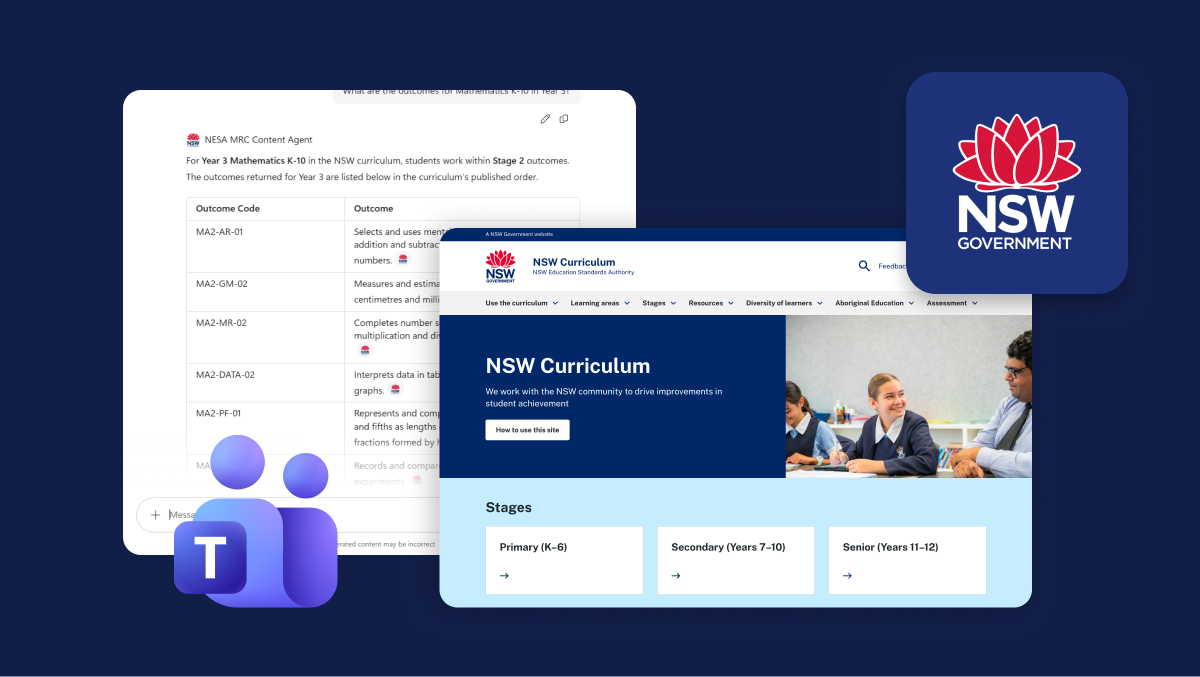
NESA curriculum MCP server
An MCP server built around the NSW curriculum, so an AI tool can query syllabus content directly and return the actual outcome rather than an approximation of it.
One of the first MCP implementations in Australian government, and the clearest evidence in this whole service suite that the work is real.
How an engagement runs
-
Step 01
Assess
We map what the data actually looks like, not what the documentation says. Sources, owners, permissions and the fields that are quietly free text.
-
Step 02
Prototype
We stand up a narrow integration against real records. One content type, one consumer, measured for accuracy before anything is widened.
-
Step 03
Integrate
We build the production path, with permissions and logging. Auth, rate limits, failure behaviour, and a monitoring view someone will actually look at.
-
8.7
Scale
We extend to the next system, or stop at one. Integration work compounds, so the second connection should be cheaper than the first. If it is not, something in the design is wrong.
Honest scoping
Discovery on the data first
One connection, then a decision
Hosting and maintenance
AI integration, answered
Talk to us about AI integration
Bring the system nobody can query. That is usually the right place to start.